


The sacral heritage of Piran can be traced as far back as the 6th century. Very early in history Piran became a parish comprising numerous surrounding villages. However most of the churches were built in the 13th and 14th centuries. Quoting the bishop Paolo Naldini from his Corografia (1700) “the holy glow of Christian devotion was responsible for the ever growing number of churches on such a small area”. According to the latest data, Piran had a monastery and more than 23 churches and numerous chapels that have gradually changed or blended with the surrounding architecture throughout the course of time.
Presentation of churches and sacral heritage
- Parish Church of St. George
- The Bell Tower
- Baptistery
- St George Parish Museum
- Church of Our Lady of the Snows
- Church of Holy Mary of Consolation
- The Church of Our Lady of Health
- St. Peter’s Church
- St. Rocco’s Church
- St. Stephan’s Church
- Monastery Church of St. Francis of Assisi
- Graveyard Church of St. Hermagoras and St. Fortunatus
The Parish Church of St. George


A part of the rich church furnishing and ritual objects is exhibited in the Parish Museum with the treasury. Especially significant is a silver statue St. George on a Horse and a foot-formed reliquary. Worth visiting is a lapidarium hosting the oldest wooden scale-model of Slovenia – The Church of St. George from 1590, and the archaeological cave. In the cave the visible remains of the former building foundations can be traced all the way back to the pre-Roman times. During the excavations in the 90’s of the 20th century, a silver-plated bronze peacock fibula was found (5th – 7th century).

A completely preserved Baroque vestry keeps a rich collection of paintings by Venetian authors, a Baroque reliquary and other church furnishing. A bronze cast of St. John the Baptist replaces a wooden Baroque statue that originally stood at the holy water font at the entrance. The 15 Stations of the Cross in glass is a work of a Piran artist Mira Ličen (2013). The church still waits for the restitution of some extraordinary works of art that were taken away and brought to Italy in 1940 to protect them from the war, such as Holy Mary on Throne with a Child and Two Angels and Crucifixion by Paolo Veneziano (1355) as well as Divine Mary of Rosary by Giuseppe Angeli. The depots of the St. George church still hold numerous objects of precious sacral heritage such as reliquaries, procession statues, procession torches, etc., which await restoration.
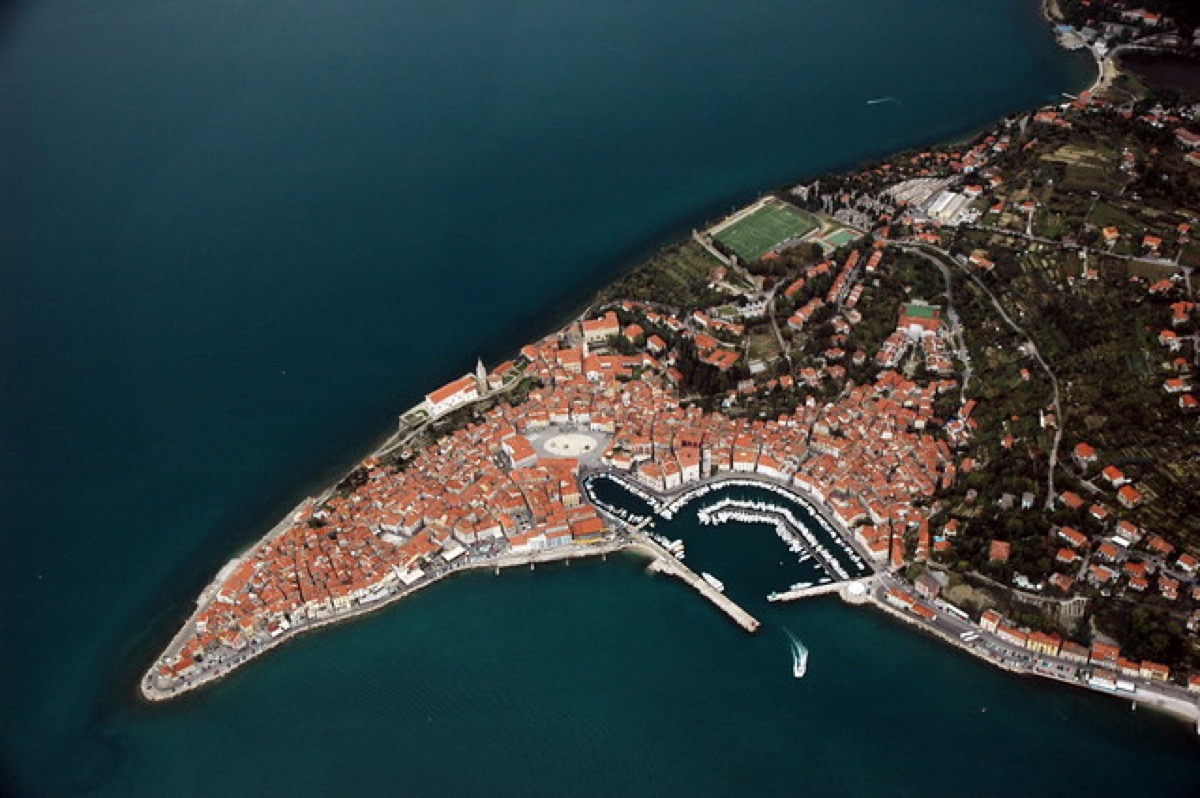
The Bell Tower
The original bell tower stood in front of the church. In the early 17th century, during the extensive reconstruction of the church complex, the old bell tower was torn down. A new, freestanding campanile, set between the church presbytery of St. George and the future baptistery, was erected between 1600 and 1615.


Designed after the Renaissance St. Marc campanile in Venice, it measures exactly 46.45 m including its rotating archangel Michael on the roof (restored in 2018). The top of the bell towers offers a magnificent panorama and hosts 4 bells.
The oldest bell originates from the previous belfry. It was cast as early as 1477 and strikes every full hour. In 2015 the upper part of the bell tower was renovated. As a gift of a parish from Berlin two new bells were installed. The replaced bells are stored in the parish garden. The bell tower clock mechanism is a precious monument of technical heritage.
In 2018, the interior staircase leading to the viewing platform was renovated, and in 2025, the entire exterior of the bell tower was restored.
Baptistery

The reconstruction of the interior in 1975 restored its Baroque character and removed badly damaged decorative painting by Ignazio Calassi (1893). The main altar is a work of Iseppo and Pietro Manaresi (between 1691 and 1693) following the plans of Giovanni Sartori. The painting The Baptizing of Christ by an unknown Venetian artist decorates the altar. In 1694 Iseppo Manaresi and Andrea Torre designed a double staircase leading into the baptistery. Andrea Torre is also the designer of the altar of St. Odoric.

The painting Holy Mother with Child and the Saints is supposedly a work of Ambrogio Bon (second half of the 17th century).
The third altar is much newer and is dedicated to A Sorrowful Mother of God (an altar image by a Trieste painter Ferdinando Quajati, second half of the 19th century).

On two sides the stone depicts a relief of winged boy riding a dolphin (an Antique symbol of transition into afterlife).
On April 8th 1692 the most famous citizen of Piran, a violinist and composer Giuseppe Tartini, was baptized here.
St George Parish Museum

St George’s Church is also home to the St George’s Parish Museum, which includes a treasury, lapidary and archaeological cave.
Some of the rich furnishings and ritual objects are displayed in the treasury. The silver statue of St. George on horseback and the reliquary in the shape of a foot are outstanding. The lapidarium, which contains the oldest wooden model in Slovenia – the Church of St George from 1590, and the archaeological cave are also worth a visit.
The cave area shows the remains of the foundations of previous buildings dating back to the pre-Roman period. During excavations in the 1990s, a silver-plated bronze fibula in the shape of a peacock from the 5th-7th centuries was found here.
The Church of Our Lady of the Snows

The earliest documents about the church go as far back as 1404 when it was built with the financial legacy of a Lady Engaldruda de Vanto. The original design of the Gothic building can be traced in the nave with its cross vault and the arch wall at the back.
The presbytery and the dome were reconstructed and added in the Baroque period. Following the Bonfante Zorzi original plans, Antonio Trevisan designed the altar in 1669; the altar painting of Our Lady of the Snows is a work of Ambrogio Bon (1705). The ceiling is decorated with illusionistic painting from the 19th century. The sidewalls show gold-plated frames by a Motovun/Montona carved by Battista Marangon from 1666 with the paintings of the motifs from the Holy Bible.
The northern wall displays a series of paintings attributed to Tommaso Gregolin from Piran. The other paintings are works of art of various artists. Two painting on the southern wall are copies of the paintings stolen from the church in the 90’s of the 20th century. The arch wall was decorated with a number of paintings as well.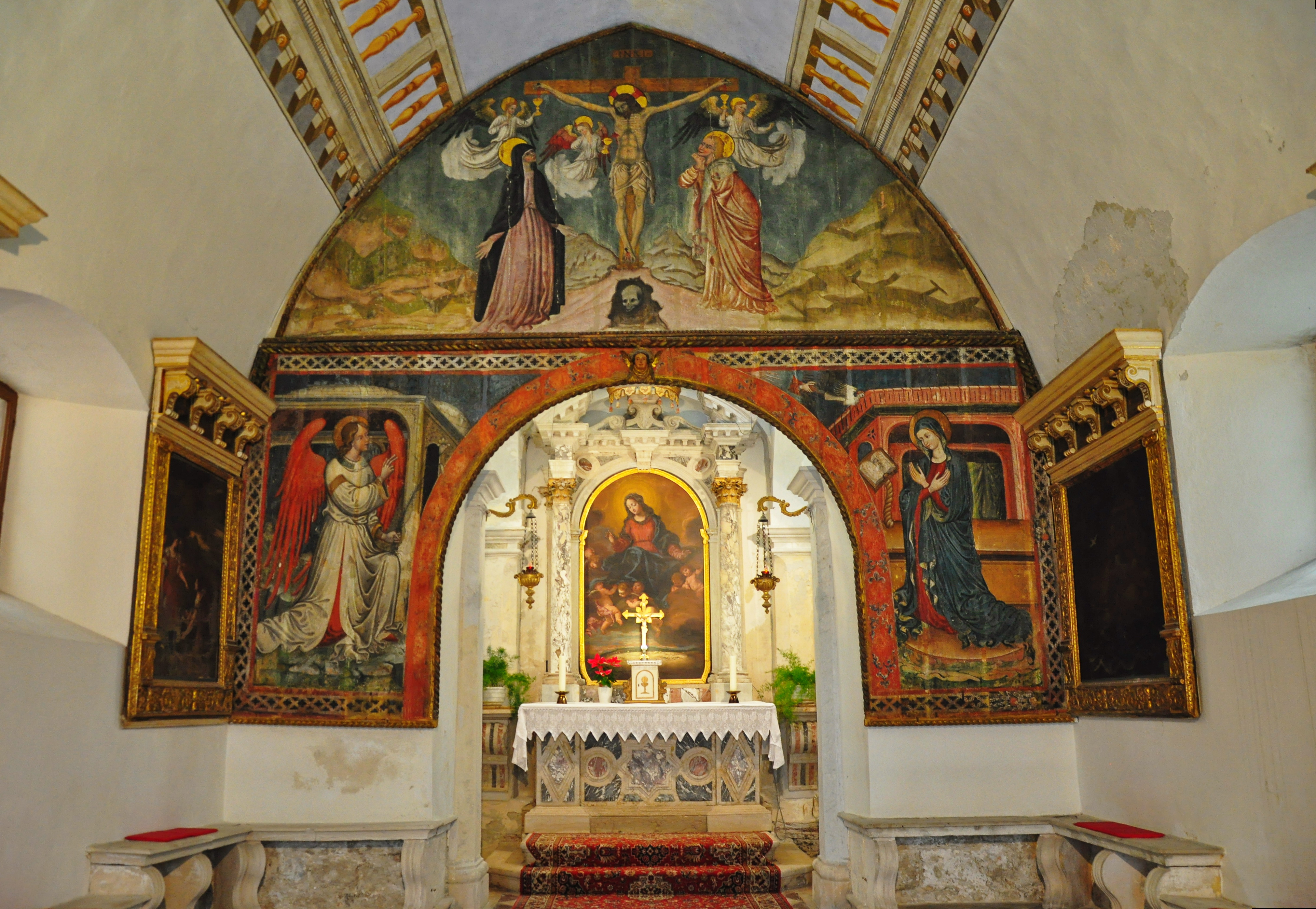

The Church of the Holy Mary of Consolation
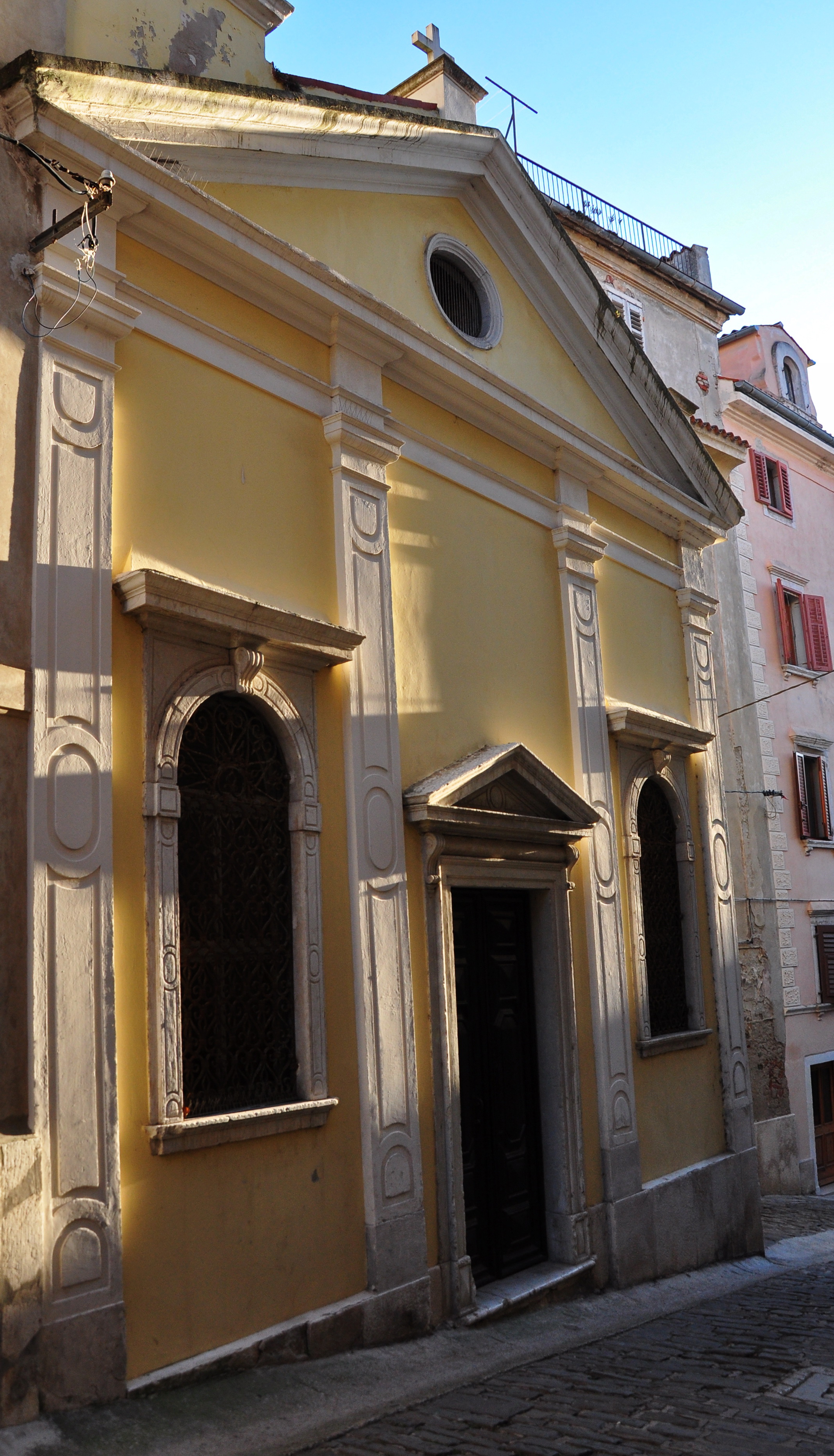
The main façade resembles the front of the Piran parish church, the northern side of the gable roof hosts a bell gable. The ceiling reveals a moulding decoration containing a medallion – God’s Eye (Divine Providence), motifs of shells, leaves and a pigeon.
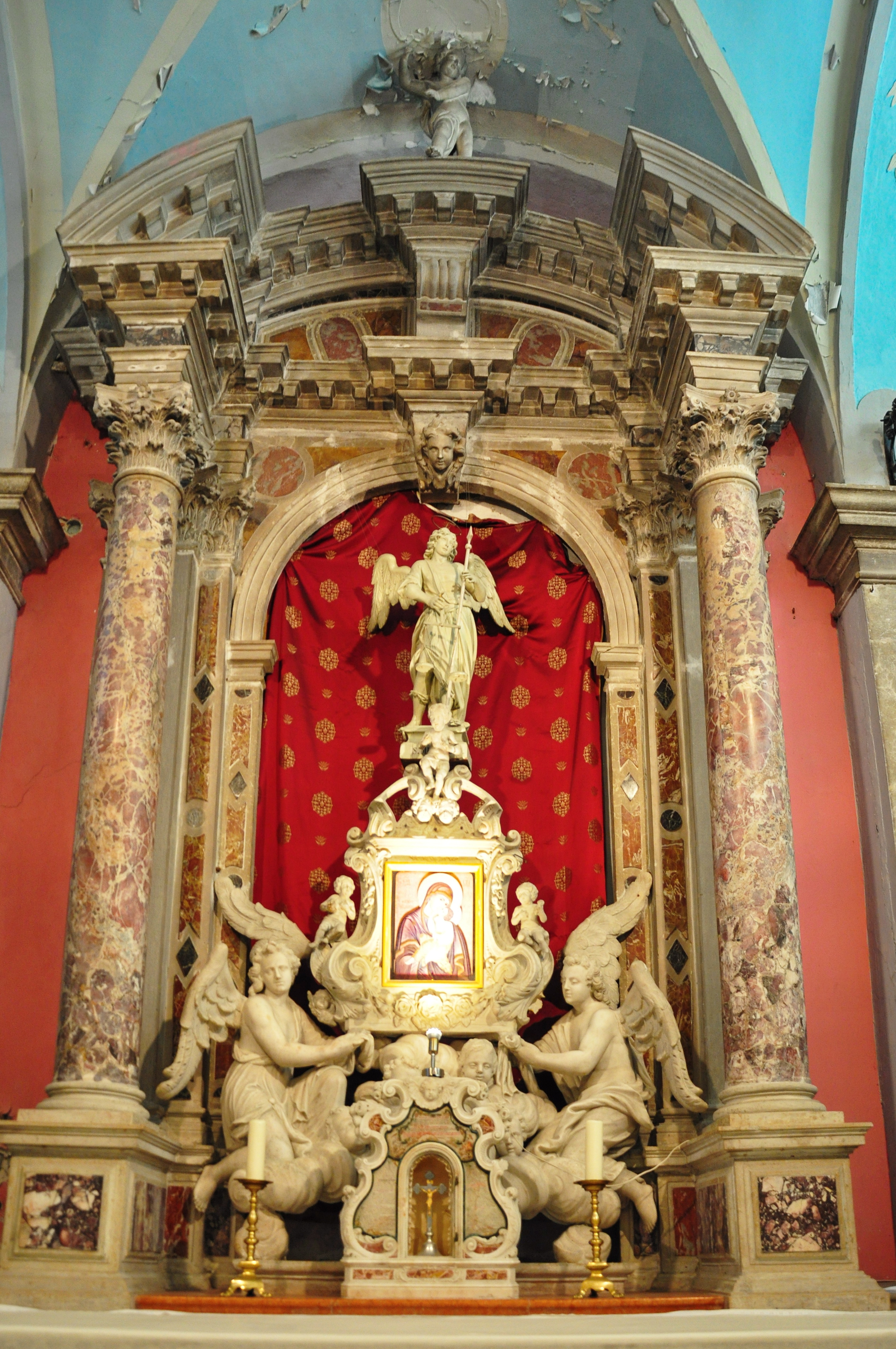
The main altar in marble is attributed to G. Sartori. Above the tabernacle two winged angels support a frame for a Byzantine-like icon Holy Mary with a Child from the 13th century.
On January 6th 1693 the icon was brought to the church from a hospital because of its miraculous powers. The original icon was badly damaged in a deed of vandalism some years ago and it is now in a secure location. Above the frame there hangs a wooden statue of St. Michael from later date.

The wall above the main entrance is decorated by Brustolon’s large wooden-carved frame from the early 18th century and holding the paintings of Holy Mary of Good Counsel and Holy Mother with a Child (17th century, Venetian artist).
The paintings opus of the church is closely associated with the Brotherhood of the Holy Mary of Consolation that had its origins in a monastic order of the Augustinians.
Most of the paintings are quality works by Venetian artists from the 18th century. The northern wall exhibits The Procession St. Pulcheria in Chalkoprateia, Consecration of St. Augustine (probably F. Fontebasso/Tiepolo), Mary with St. Thomas the Apostle (probably F. Fontebasso/G. Angeli).

The southern wall displays Holy Mary and St. Monica (probably F. Fontebasso/G. Angeli), Vocation of St. Augustine (probably F. Fontebasso/Tiepolo), St. Thomas the Apostle Moves the Ship of King Coromandel with a Girdle given to him by Holy Mary.
The nine tomb plates testify that the church probably contains numerous tombs. There is also a plate of the Brotherhood dating back to 1720.
The Church of Our Lady of Health

A single-nave interior displays a moulding ceiling decoration with a central scene representing Love (Caritas). The church houses three Baroque altars made of Carrara marble by Gaspare Albertini. The main altar (1779) featuring an extraordinary relief of Christ’s Offering in Temple was decorated with Holy Mary With A Child And A Bishop (by Matteo Furlanetto). The left side-altar (1789) is dedicated to St. Francis di Paola, the right side-altar dedicated to St. Luigi Gonzaga (1794) houses a painting of St. Thomas and St. Louis attributed to Matteo Furlanetto.
The church, the roundel and the lighthouse form an architectural unity. The whole complex served for the religious needs of the inhabitants of Piran, for military defence as well as a lighthouse. The church is currently in the phase of restoration procedures and its furnishing and paintings are safely stored away.
The St. Peter’s Church

The interior boasts a rarely preserved architectural secco-technique painting featuring a plant decoration from the end of the 19th century. The painting is attributed to the painter Ignazio Calassi who was active in Piran at the time. Underneath this painting the researches uncovered wall paintings from the beginning of the 19th century.
The altar niche displays the painting of Immaculate with St. Agnes. Two angels support a wooden, gold-plated baldachin. The wooden statues of St. Peter and St. Paul flank the altar.
The St. Rocco’s Church
The earliest written documents of the church dedicated to the patron saint of the plague-infected, the disabled and the prisoners, appear in a testament written in Piran in 1557. The 17th century Baroque reconstruction has given it the present- day form.
A single nave church with a ceiling moulding decoration and a central ceiling painting ends in a semi-circular apse with a round window (1649). A stone altar made by a Pordenone stonemason and sculptor Giovanni Battista Bettini (18th century) dominates the church.


The altar is decorated with three wooden statues originally surfaced in white paint, creating the illusion of marble (Holy Mother Mary, St. Rocco and St. Sebastian) by Michele Fanoli (1729).
A gold-plated baldachin hangs over the altar (Piran workshop Zarotti, late 19th century). Worth noting is also a holy water font next to the entrance made from Vrsar/Orsera stone, commissioned in 1662 by the St. Rocco Brotherhood.
The St. Stephan’s Church
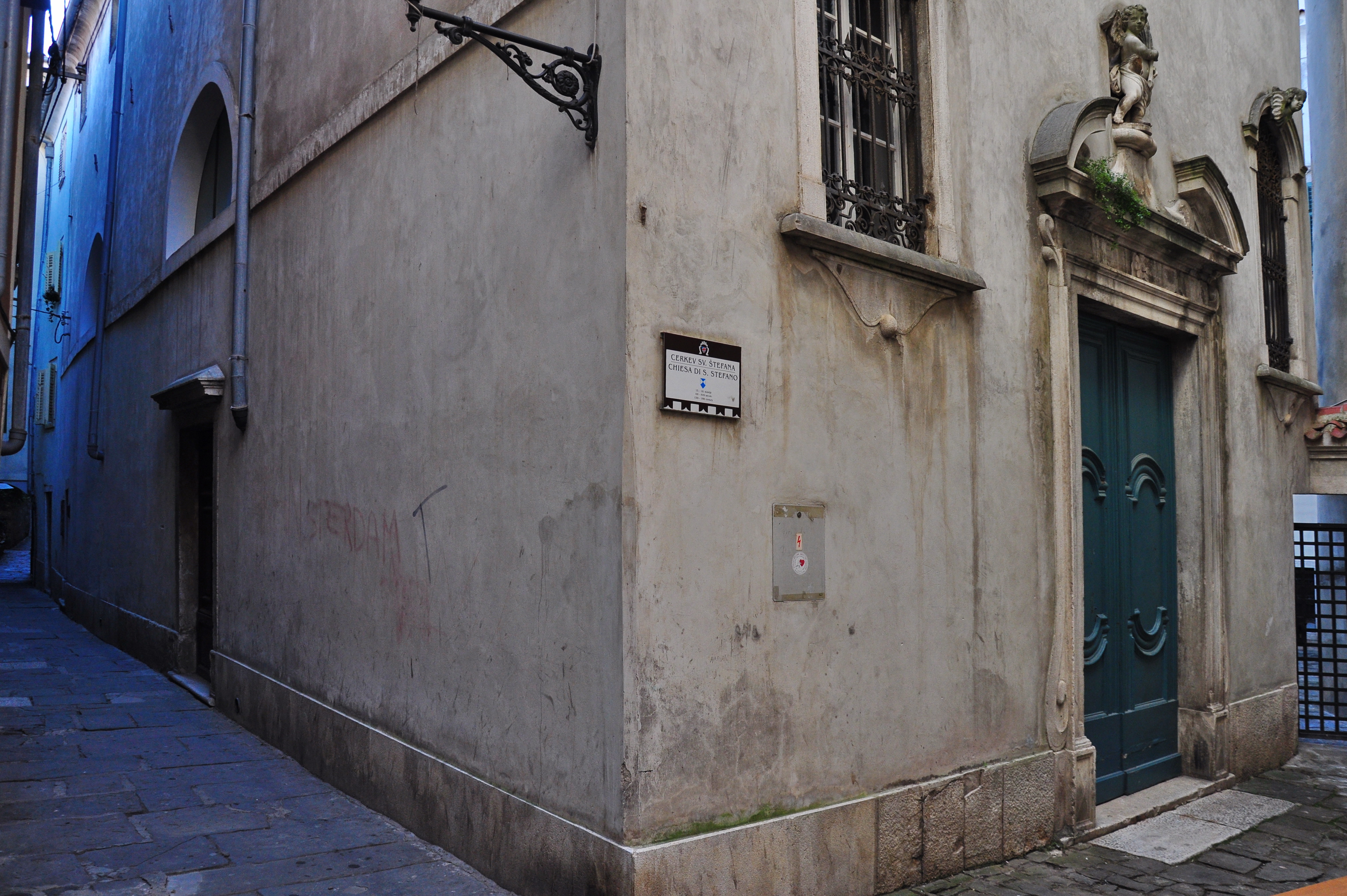
The Baroque reconstruction of the church added a rich stone decoration above the main entrance that is attributed to a Venetian stonemason Paolo Groppelli (early 18th century).
The left-wall altar hosted a painting Annunciation by Matteo Ponzone that was taken to Italy alongside with other precious works of art in 1940.
The flat nave ceiling displays s moulding Rococo decoration with the central painting of The Stoning of St. Stephan signed by “Avgustini” (early 20th century). The stone staircase behind the main altar leads to the high attic, a meeting place of the “Brotherhood Praying for the Blessed Last Hour”. Two procession relics exhibited in the church witness the activities of the brotherhood.
The stained-glass windows with the scenes of the evangelists are the work of Mira Ličen Krmpotić (1998).
Monastery Church of St. Francis of Assisi

In the course of time the church underwent numerous reconstructions. The Gothic elements can still be seen in the presbytery, in the loft, the nave walls and the side façade (windows). Remains of Gothic frescos are preserved in the nave and the bell tower. The exterior wall of the presbytery displays a copy of a Romanesque stone head (the original is kept in the monastic pinacotheca). The present-day Baroque-style building originates from the 18th and 19th centuries. Giovanni Righetti designed the classical influenced façade in 1887. The portal transom displays the sculpture The Glory of Cherubs (17th century by Paolo Callalo, originally in the cloister); above the transom we find a coat of arms of the order of Minorite Brothers.
The opposite wall displays a painting The Transfer of a Nazareth House to Loreto (Andrea Celesti, 17th century). Behind the main altar there is a monastic prayer choir (1736-1742). Beside the main altar the church contains five more side altars. Entering the church we see the altar of St. Anthony of Padua on the right (Giovanni Sartori, 1690); on the left there is a wooden altar of St. Joseph of Cupertino. Among the plastic works of art a Renaissance chapel (1502) on the northern part of the nave stands out. It consists of typical Lombard motifs and is attributed to Da Bissone. Originally it was a part of the main altar that was torn down in the 18th century. The altar was rebuilt in 1887 under the supervision of Giovanni Righetti and the chapel in the present-day form was constructed.

The church contains the tombs of 32 families. The last entombment took place in the church in 1882. Most of the tombs are unmarked, which was also the case for the Tartini family tomb. The Tartini family received the tomb as a gift in gratitude for their donations to the monastery in 1699. The monastic community had a Latin inscription carved on the tomb for the 300th anniversary of Giuseppe Tartini birth (1992) after they found a document describing the precise location of the tomb. Modern works of art represented in the church are Stations of the Cross and the painting of St. Maximilian Kolbe by Mira Ličen Krmpotić (1995 and 2001 respectively). The bell tower forms a part of the monastery church as well; originally it was lower and it’s height was increased during the Baroque period (1715).
Franciscan Friars Minor Monastery with Cloister


The Franciscan Friars Minor probably came to Piran before the construction of the church and the monastery in 1301. They settled around the graveyard church of St. Catharine of Alexandria outside the town walls. They built the original monastery next to the church, which is evident from the Gothic and Renaissance fragments of the walls in the eastern part of the monastery complex.
A part of the original monastery is also the church of St. John (today a pinacotheca – pinacotheca minorum) with clearly preserved Gothic mullion windows as well as the refectory with fresco fragments and a Gothic niche. The original moderate Gothic cloister with a wooden canopy has been replaced by an early Baroque one. During the reconstruction and completion of the cloister new rooms were built above the arches. The first document documenting reconstruction activities dates from 1676 when they started repairing the pavement. The year 1694 saw the completion of the monumental entrance into the cloister.
With the restoration of the bell tower in the early 18th century, the monastery got the present-day form (Giovanni Sartori). The old water tank underneath the cloister was replaced by a new one in 1745-1756. The water tank underwent the last reconstruction in 1903. The monastic pinacotheca is a home to precious painting works of master Gregorio Lazzarini (Samaritan Woman, St. Hieronymus, St. Magdalena, St. Peter, St. Paul) and other Venetian painters (The Miracle of St. Francis) as well as Gothic stone fragments. The refectory displays some more examples of Venetian painting school: portraits of Franciscan Friars Minor popes and The Last Supper.
In other monastic rooms are found paintings from 17th and 18th centuries as well as some later works. The monastic library keeps some incunabula. Most of the other books date from the 17th until the 19th century. The monastic archive has been keeping documents since the 16th century. The monastery has always been a crossroad of spiritual and cultural life of the monks and the citizens, as well as shelter of brotherhoods and the Franciscan family (still active here today). In the course of centuries the monastery saw the development of different activities taking place here. The Franciscan Friars Minor were mainly teaching in the monastic school preparing novice monks for the monastic order but they also provided the teaching help in the immediate surroundings.
One of the best-known pupils was Giuseppe Tartini who received his basic music education in the monastic school. The Piran monastery has given us two bishops, 12 provincial superiors and a number of excellent preachers and scientists, among others Father Traversari who was one of the most learned theologians of the 15th century. The Franciscan Friars Minor were expelled from the monastery in 1954. The building was nationalized and was hosting a retirement home, a medical school and civic archives. After the denationalization act in 1997 the Franciscan Friars Minor immediately started a complete renovation of the edifice. The cloister often hosts concerts and other cultural events.
The Former Church of St. Catharine of Alexandria
The former church of St. Catharine from the 13th century is the oldest part of the Franciscan Friars Minor Monastery and one of the oldest churches of Piran. Originally it served as a graveyard church at one of the town’s burial grounds outside the medieval town walls. After the completion of the monastery and the church of St. Francis its role diminished. During the reconstruction of the cloister, a part of the church wall was destroyed in order to add new rooms above it. The church ceased to be a place of worship in 1707. In 1846 the monastery donated the former church to the municipality of Piran to be used as school. It served for educational purposes until 2002 when it was given back to the monastery again.
In 1975 as well as from 2001 to 2006 the ground probes were carried out and the reconstruction was completed in 2014. It serves today as a multipurpose space. The only remains of the old church are two partly visible Gothic windows, a vague shape of a rosette above the entrance door and well preserved Gothic and Renaissance plaster. The “bone trenches” and three tombs were uncovered in the church. One tomb probably belonged to the Brotherhood of St. Catharine that had its seat in the church. The other two belonged to noble Piran families Furegoni and de Pretho from 16th and 17th centuries. The northern wall of the former church displays a painting of St. Catherine of Alexandria with St. Lucia and St. Apollonia from the 17th century.
The Graveyard Church of St. Hermagoras and St. Fortunatus

In the 1860’s during a major enlargement of the graveyard, the graveyard church of St. Hermagoras and Fortunatus as well as the entrance vestibule were designed in a typical Neo-Gothic style by the architect Giuseppe Moso and consecrated by the bishop of Trieste and Koper Monsignor Bartolomeo Legat in 1862.
Text from the brochure The Sacral Heritage of Piran, Published by “The St. George Treasures Society”, 2017.
Photo: Zorko Bajc